Showing posts with label Outdoors. Show all posts

Monday, 16 March 2015

2, 2 minute talks

... Continuing from my previous post about university interviews, here are the 2 short talks that I prepared and gave.

The first talk was regarding homework in primary schools:

"Homework has been the topic of controversy for many years; not only within the UK but around the world with some teachers and groups such as the Parents Outloud charity calling for schools to abolish it all together; following in the footsteps of some areas of Europe such as Denmark which has piloted homework-free schools.
John Hattie (Professor of Education at the University of Melbourne) described homework as “low hanging fruit” in a recent BBC interview, continuing with the surprising finding that homework in primary schools in fact has no impact on children's achievement. Despite this, he does not call for homework to be abolished, but rather for teachers and schools to rethink the value of the tasks and work that they are setting.

I am involved in many discussion groups on the social network 'twitter', where professionals from the early years, primary and secondary sectors can share ideas and discuss relevant issues. During these talks I have found that many Primary Teachers share the feelings of Professor Hattie that homework can be beneficial to children if it is used to reinforce the learning that takes place in the classroom, however it is vital that homework is planned with the same rigour as lessons and involves stimulating activities, rather than just tedious or 'boring' tasks.

On reading many of the Homework Policies for (my town's) Schools, I found that homework is promoted as a valuable link between home and at school, allowing parents to become involved in the learning and development of their children. Many parents wish to be helpful and engage with their child's education and well planned homework can allow them to do this. Unfortunately it can also be said that homework is a major cause of friction and stress within many households, which raises the concern of children being discouraged from learning as they begin to associate work with being source of conflict with parents rather than a positive learning experience.

Completing homework can provide children with many valuable skills such as time management and responsibility and abolishing homework would be damaging as it prepares them for high school and later life where increasing amounts of self led learning is essential.
Despite this it is also important to remember that children need appropriate amounts of 'downtime' and that there must be a degree of separation between home life and school. Especially for children with difficult home lives or for those who find school particularly challenging.

When setting homework, teachers should take into consideration that extra curricular activities such as sport or drama clubs allow children to continue their learning in different ways. If vast amounts of homework is set then children who engage in these extra activities are left with less and less time to relax and recharge before beginning the next day. Professor Hattie pointed out in his study that 10 – 20 minutes of homework is just as valuable as 1 – 2 hours. This again comes back to the quality of the homework being set.

In conclusion, In the hands of passionate, skilled teachers; I feel that homework can be a valuable tool to extend learning and to enrich knowledge that is learned in the classroom. However it is vital that homework is planned and only given when it will benefit the children's learning rather than being set simply because a policy says so."


My second talk was about outdoor learning:


"As the interest in learning and playing outdoors continues to grow both in the UK and internationally, I have decided to speak to you today about some of the benefits of outdoor education and learning through nature.

Outdoor education defines any learning that takes place outside of the school walls, whether it be in a playground or further afield in a forest or on a beach. In Scotland we are lucky enough to have access to a huge variety of natural environments and it is essential that children are provided with opportunities to explore the wonder and magic of their natural surroundings throughout their education.

The curriculum for excellence states that in order for children to develop into Confident Individuals, they must be provided with opportunities to be active. There is a frightening prediction in The Foresight Report (2007) which concluded that half of the UK population could be obese by 2050 and with the temptations of technology such as television, ipads and video games, it is easy to see this becoming a reality.
By taking children out of the classroom and engaging them in outdoor learning, teachers are able to promote the benefits of an active lifestyle and the enjoyment that goes alongside exercise.

Outdoor education allows for many different learning styles, from visual to kinaesthetic and provides children with relevance and depth to the curriculum as they are able to apply their learning within real life contexts. Learning in this way promotes self esteem and confidence, it can also be used to teach team work and problem solving as well as improving attitudes towards the environment.

From my own first hand experience working within a pre school which promotes outdoor education and forest school experiences, I have witnessed the positive impact of outdoor education, including increased motivation and enthusiasm for learning, that continues even on returning into the classroom environment.

Of course, there are many factors which must be given careful consideration when taking learning outside. Risk assessments must be rigorously completed and accessibility for all students, including those with additional special needs must be taken into account. However, with careful planning and preparation, teachers are able to overcome these challenges in order to provide valuable experiences for the children.

I believe that taking education out of the classroom gives them access to a wealth of benefits and by allowing children to explore and investigate of our natural world, together we can ensure that learning is powerful, exciting and rewarding."


Keep in mind, I had a 2 minute limit for each, and there is so much more I could have said about either topic!


Sunday, 21 September 2014

Nature Journals

There are so many different ways to include mark making and writing in the outdoors, but one activity that the children in my nursery particularly enjoyed was to create and continually add to their very own nature journals.


These journals can be as simple or complicated as you want them to be, we used large 'nature coloured' sugar paper and bound it with a long stick at the spine, we then decorated our journals by painting using sticks, leaves, flowers etc.
Don't forget to encourage the children to write their names on their journal! They should be able to take ownership of their own special book and feel proud and excited by it.
If you wanted to be extra creative, you could make your own recycled paper (maybe including some pressed flowers) and use it to create beautiful book covers.
Be sure to add plenty of pages inside and if possible, use thick, sturdy paper that will not rip if it gets a little damp or beaten while the children are out and about.

Another nice touch that you could include into your nature journals is to add small plastic pouches or pockets so that the children can store and keep small pebbles, shells and other exciting materials. They can then bring them back to nursery and continue to explore their discoveries in other areas.

Once your nature journals are ready, collect some pencils, glue, sticky tape and scissors and take the children outdoors! It really doesn't matter where you go, the woods, the beach, the garden or a walk around the block, but as you're playing and exploring, encourage the children to collect small natural items that they find interesting, or draw a picture of them, or write the words!

When mark making outdoors, ensure to provide your children with a range of materials such as chunky pencils, felt pens, chalk, crayons or paints. If you provide a variety of resources, you are likely to find a method that appeals to most children, rather than putting anyone off (for example, one of my children would never choose to write or mark make unless felt pens were on offer – then there was no stopping them!)

My children were fascinated by all of the different types of leaves that they came across while exploring the outdoors. They glued them into their nature journals, drew around them, took rubbings of them and matched and sorted them into groups of colour. This was fantastic for early maths skills as well as science, expressive arts and of course, language and literacy as they learned new vocabulary and attempted to write them.

The more that you take your nature journals out with you, the more confident the children will become in adding into them. A nice way to promote this learning is for the adults/ teachers to have their own nature journals as well. Remember, if you are excited and engaged in an activity, the children will follow your lead!


Later, the children's journals can be used as an aid for reflecting on their learning. They be able to look back through their book and speak about previous trips and findings, encouraging their language skills further.


Don't forget to allow your children to show off their work to their parents, or maybe even take them home for the weekend and add some treasures from their own back garden – this learning certainly does not stay within the nursery!

Saturday, 30 August 2014

86 ideas for fabulous outdoor fun (Part 4)

Well, it certainly has been a while since my last post! Apologies for this but I have been a very busy cookie - I have left my position at the nursery to return into the world of education. I have finally decided to take that big step and train to become a Primary Teacher! Wish me luck!

The other, very exciting, thing that has taken up an awful lot of my time is... I got married! On the 9th of August I was lucky enough to become the wife of the most fantastic man, and enjoy the best day of my life surrounded by family and friends.

Anyway! Enough about me - let's get back to thinking about the children and the many, many, many, MANY fantastic outdoor learning experiences


Caring for our environment


It's so important to teach children about the wonder of our environment and our impact on it. Here are a few ideas to get children thinking and caring...

Creating habitats


Attract creatures to your garden by building some simple habitats:


  • Minibeast home - You can use some natural resources to build homes for creepy crawlies. Use sticks and logs of all different shapes and sizes to create lots of nooks and crannies. Alternatively a cardboard box or an old pop bottle could be used. You can also use leaves or soil/ compost to create damp areas as well as dry. The best minibeast homes blend in with their natural surroundings.
  • Hedgehog home - Turn over a crate and cover it with soil and other natural resources to make it blend in with the surroundings. (Oh and make sure that there is a way for the hedgehogs to get in!)
  • Bird home - You know what a bird house looks like! But why not try your woodwork skills and build a 3 sided house that you can attach to a window. Add an entrance and some dried grass/ leaves/ something to make it into a cosy home. This way the children can see right inside as the birds use the home.

What are the children learning? 
They're learning about the different types of life in the world around us. They're learning about our impact on this life and how we can help or hinder it. They're learning about designing and creating, as well as choosing appropriate materials and they're learning about following instructions and working together. Oh, and of course the skill of observing the wildlife as well!

Planting and growing

I don't think I need to go into too much detail here - whether you have a plot of land, a corner of the garden or just a window box - children are fascinated by the process of planting and growing!

Some extension activities:
- Plant a range of seeds and have a 'race' to see which ones grow the fastest
- Try and guess the plant by looking at it's seed 
- Place one pot in a dark place and one in a light place and observe the differences as they grow (or don't grow as the case may be!) 
- Keep a 'Growing Diary' with pictures, words or even photographs. This is a great way to allow the children to use all of the new words and vocab that you'll have been teaching them throughout this activity.
- Measuring the plant's growth using a range of equipment such as rulers or tape measures.
- Picking and using and fruit/ veg that you have grown and using it in your food technology!

What are the children learning?

They are learning the science of the process of growing. They are learning about the variety and diversity of plants and growth around us. They are learning maths and through measuring growth and language and literacy through recording their observations.

Bird Feeders


Here are 2 simple ways that you can make your own bird feeders:


  • Use a large pine cone, smother it in butter or lard (messy and fun!) and then roll in bird seed. Attach string and viola!
  • Take some stale bread. Use a biscuit or playdough cutter to cut it into an attractive shape. Then use a sticky substance like honey and cover the bread before sprinkling with bird seed.
Make sure to hang them somewhere which is close enough that the children can observe through a window, but not too close that the birds are too afraid to use it!

What are the children learning?
So many things!:
You could add some books/ bird spotting sheets around the window area and allow the children to recognise and appreciate their local wildlife. They are learning about their impact on the creatures around them. They are learning to be quiet and patient while observing. Add some paper and pencils and encourage them to draw any birds that they see - bringing art and creative skills into the activity.

Litter picking

It's a bit sad, but I always really enjoy this activity!

Image from amazon.co.uk
Make sure to have a chat with the children before you head out about safety - make a mind map or 'risk assessment' including the essentials - namely - we do not touch the litter! And when we return to nursery - we wash our hands!

When I lead this activity, I read the children a story called 'Dinosaurs and all that rubbish' (Michael Foreman) which is a fantastic conversation starter. I then kitted the children out with rubber gloves and litter pickers, along with a few plastic bags.
(Now, we only had a few litter pickers, so I was able to include the all important skill of turn taking throughout this activity!)
When you get outside, it wont take long (sadly) to find some litter. Watch the children's co-ordination and motor skills develop along with their problem solving as they work out how to use the litter pickers to move the litter into the plastic bag. This could also be a great opportunity for teamwork if you have some children holding bags while others use the pickers.
As this activity continues, you can talk to the children about which objects are/ are not litter. How can you tell? Do you think this object should be here? What could happen if we leave our litter on the ground? What should we do with it? ... You get the idea :)

What are the children learning?
They are learning to be responsible citizens, to care for their environment and appreciate the world around them. They are also developing their thinking and speaking skills as well as physical capabilities.

Composting

This is a lovely side activity to link in with your gardening activities.
Here is a link to the BBC site with a step by step guide to get you started!


What are the children learning?
That garden and food waste can be re-used to create something valuable! They are also learning to be patient (composting does not happen over night) as well as all of the skills they they are gaining from their planting a growing activities.


You might also like:


Part 1: Let's get physical 


Part 2: No resources? No problem!


Part 3: Out in all weathers

Saturday, 1 February 2014

86 ideas for fabulous outdoor fun (Part 3)

Out in all weathers!

I don't want to hear any excuses! Make sure your children (and you) are dressed appropriately, whether that means wellies or sun cream, and get outside! 


First up: a couple of ideas for Sunny Weather  


  1. Have you tried shadow tracing? Get some chalk and a clean part of the path, or some big paper and encourage the children to experiment with tracing around the shadow shapes that they can see. You could let them trace each others shadow, try to trace their own (not an easy task!) or even use some construction materials to build models that will cast unusual shapes. This activity develops children's hand-eye coordination, imagination, and allows them to begin thinking about light and how it travels. You could extend this activity by creating some shadow puppets or exploring the way that shadows move and change throughout the day. What happens to the shadows on a cloudy day?
  2. Have a water fight! What better way to spend a hot and sunny afternoon than throwing and catching wet sponges (spatial awareness, coordination, gross motor skills), running past the spraying hose (gross motor skills, confidence), and finding ever more ingenious ways to soak one another (logical thinking, problem solving)? On top of this, the children are learning about how water moves and can be transported, they are also learning about evaporation as they notice their clothes becoming dry in the sun. I recommend a thorough risk assessment of this activity as wet surfaces and running can often be a dangerous combination. Oh, and don't forget to have a change of clothes for yourself as well as the children! I have made this mistake before!
  3. Sunny days are the best kind of days to go on a bug hunt! Encourage the children to think about what kind of creatures might live in the garden, then get out there and find them! Don't forget your magnifying glasses, bug books and creature catching pots to further their investigations! This activity allows children to appreciate the world around them, think about the many different creatures that share our world with us. It also develops their investigation and natural curiosity
There are so many more, but I couldn't possibly write about them all! Next, Rainy days

  1. Rain Catchers are an easy way to bring some numeracy into the outdoor environment. A very simple method to create one is to use a 2 litre pop bottle, cut it in half and insert the top end into the bottom so that it forms a little funnel. You could allow the children to use a ruler and marker pen to create markings on the side of the bottle so that they can easily measure the volume of water. A lovely experiment that you and your children can carry out is to place a few rain catchers in difference places around the garden - out in the open, underneath a tree, on top of a slide... leave them for a time and when you return, investigate which contains the most rain water. Encourage the children to think and reason "Why could this be the case?"
  2. As mentioned in my last post (No resources, No problem!) Splashing in puddles is a wonderfully fun, messy, and surprisingly educational activity! No resources? No problem!
Again, I have barely scratched the surface,  but let's think about Ice and Snow

  1. The cold weather is a perfect opportunity for your children to learn about the different forms of water through Freezing and Melting. The children at my nursery love to go on an ice hunt first thing in the morning. Any little containers or places where water might pool is possibly hiding a frozen surprise. Allow your children to hold the ice in their hands. What happens? Why does this happen? Can we stop the ice from melting? You could also involve the children in making their own ice by leaving some small containers of water overnight. Why not drop a little toy into it to see what happens? Or some sparkly glitter? Or even paint! You could extend this activity to see if other liquids freeze in the same way - for example, Does ketchup freeze? Another extension would be to allow the children to investigate the effects of salt on ice. 
  2. Building a snowman (or woman) encourages children to work together as a team. It develops problem solving and logical thinking as they work out how to move snow from one place to another, and how to build the snowman without it crumbling or toppling over. Another learning opportunity during this activity is to explore facial features and body parts
  3. Have you ever tried painting the snow? If not then I urge you to try it! The snow absorbs the paint and the paint also causes the snow to melt a little, creating beautifully weird and wonderful patterns and designs. This activity allows children to be creative, and also develops fine motor skills (or large, depending on the equipment you might use) and co-ordination.

Last of all: Windy weather!


  1. Let's go fly a kite, up to the highest height! A fun and calming activity that can involve some teamwork (getting the kite into the sky) and can also be used to encourage sharing and turn taking. And of course if you want to take it further, you could ask the children to think about "What is wind?" "Can you see the wind?"
  2. Let's make our own wind chimes! Provide the children with a variety of items that will make a sound when the wind blows (spoons, keys, wooden tubes, bells, shells... you get the idea) and when the children have finished their creative, imaginative fun you can hang them around the garden, wait for the wind and listen to the wonderful sounds that they make. 
Next Post: Taking care of our environment

Thursday, 16 January 2014

86 Ideas for fabulous outdoor fun (Part 2)

No Resources? No Problem!

Whoever said that you have to have tonnes of fancy resources to engage and teach children?

Here's a few ideas that wont cost you a fortune:


  1. Make a daisy chain! 

    How many of us remember this one from when we were children? It allows children to use their observational skills to hunt out the daisies and also their fine motor skills and hand-eye coordination while poking a hole and threading the stalk through. You can count the daisies, notice the colours and make comparisons to other flowers, 
  2. Flower pressing. Go for a walk with your children and allow them to pick some flowers. Then, trim your flowers and, using some heavy books with absorbent pages (telephone directories etc), place them in between the pages. Unfortunately, to do this properly, you do need to leave them for some time (I've heard it can take up to 4 weeks!) but for the purposes of learning and fun, you could experiment with different amounts of time. This activity allows your children to appreciate plants and flowers as they pick the ones that they love, they learn about weight and size and can make comparisons between different books when selecting the appropriate ones to use and of course, it can lead on to some fantasticly floral Artwork using the finished product.
  3. Potions. One of my particular favourite activities! I have blogged about potions before...(http://piratesandprincesses.blogspot.co.uk/2013/08/lets-go-outside.html). You can allow the children to choose their own 'ingredients' out of anything and everything that they can get their hands on - and let the learning commence! 
  4. Splashing in puddles. Peppa pig loves splashing in muddy puddles and so do we! Just because it's raining outside doesn't mean we should stay cooped up! Splashing and jumping helps to develop children's Gross motor skills, they begin to make connections between how high they jump and how big a splash they can make, they can learn about how water moves and changes and they can learn about depth and volume. You could also extend this to look at the different clothing that is suitable for different weathers and find out how the water can affect different materials - "would a paper raincoat keep us dry?" "What about wellies made out of wood?". 
  5. Climbing trees. Yes! It's so important to encourage and allow your children to take risks and manage their own safety! As long as there is an adult on hand to help if they get into a bit of a sticky situation and to ensure that this risky play doesn't turn into dangerous play.
  6. Counting the rings on a tree stump. Around my nursery there have been a number of trees chopped down. The children noticed the stumps while we were out walking and while they were climbing on them and having all kinds of physical fun play, I asked if they knew about the rings. Surprisingly none of them did! This lead on to a wonderful discussion about the age of the trees and encouraged the children's counting skills. It also prompted them to begin wondering about the different types of trees and whether all of the big trees were old and small trees were young? (Mathematical language and comparisons.) 
  7. Mud pies. Mud is fascinating. One minute it can be hard and solid, the next dry and crumbly, the next powdery and dusty and the next sloppy and wet! Making mud pies can encourage children to talk about these changes and experiment with some descriptive language. They can develop their hand - eye coordination while scooping and pouring and they can definitely use their imagination!
  8. Cloud spotting. The next time you have a nice-ish day with some fluffy clouds, take the children outside, lay down on the grass and look at the clouds (yes, you can tell the boss that you're 'working!') Encourage the children to use their imagination and language skills to describe what they see. You can make this as simple or complex as your children's needs require - for example spotting shapes or extending this into telling a story using the 'characters' that they can see in the sky. You can also take this into Art and allow the children to draw the things that they have seen
  9. Rolling down the hill. The children at my nursery LOVE this game. We are lucky enough to have a hill with a steeper side and a more shallow side so that the children can make decisions and assess what they feel comfortable and confident with. Again, allowing the children to manage their safety by showing them how to take turns or space themselves out appropriately is very valuable. And while the children are rolling down the hill, they are beginning to learn about gravity, and about speed and motion (and they just think that they're having fun!)
  10. Hide and seek. This game works best in an area where there is plenty of space, but clear boundaries. An enclosed garden perhaps (at least to begin with) or an outdoor space that the children are familiar with. This game encourages turn taking, counting skills, spatial awareness, problem solving and logical thinking skills. It's also tonnes of fun!
Next post: Out in all weathers!


Friday, 10 January 2014

86 Ideas for fabulous outdoor fun! (Part 1)

Over the next few posts I'm going to list some of the oh so many wonderful experiences and opportunities that children can gain from getting outdoors! I've broken then down into sections (rather that writing one long list) for your convenience and I've even added links to the curriculum! I spoil you so!

Let's start with some action...

Let's get physical!
  1. Nice and simple to start with: Games. These can be as simple or as complicated as you like or your children can manage.

    A favourite game with my children just now is "What's the time Mr Wolf." Races are also lots of fun and can be adapted to become accessible to children of many different abilities.
    Football is also an ever popular game - particularly with the boys. 
    (Counting, running and chasing, taking turns, teamwork and following rules.)

  2. Balls: How about a game of throw and catch? Or throwing balls into containers of various sizes! What about rolling the ball to each other? Maybe I can even throw the ball all the way over the top of the slide! (Gross motor skills, spatial awareness and hand-eye coordination.)
  3. Parachute: If you work with children and don't possess a parachute then I urge you to get one!
    There are many different games and activities that you can play:
    'colour swap' is a game where children who are standing at particular colours must run underneath the parachute to swap places (colour recognition, listening skills) Another parachute game for you to try is 'don't drop the ball!' where you place a large (I recommend a fairly soft) ball on top of the parachute and the children must prevent it from falling off at their side
    (Team work, co-operation, gross motor skills)

  4. Bikes: What could be more fun than whizzing along the path on a bike, or bumpity bumping along the grass on a push along toy? Bikes and scooters are fantastic resources for gross motor skills, confidence, balance and coordination. Push along toys can be helpful for building up strength in children's legs as well as building their confidence before moving onto bikes.
    (Turn taking)


  5. Ropes: skipping ropes and chunky ropes can be used in many ways. A rope could mark out a pathway, create a barrier, allow a place for washing to dry or could encourage children to jump and hop. Why not try wrapping a rope around trees and encouraging the children to climb over and underneath? (Gross motor skills, coordination, balance)

  6. Obstacle course: This could be introduced in 2 different ways.
    It could be a course that is set up and built by adults to promote particular movements and allow for children of different abilities to explore and investigate. (Gross motor skills, balance, coordination, turn taking, safety awareness)


    Or it you could provide the materials and resources (for example planks of wood, crates, logs, stepping stones...) and allow the children to create their own course. (Problem solving, gross motor skills, balance, coordination, turn taking, teamwork, safety awareness.)


  7. Walk the line: is a simple game where the child simple has to walk along a line which could be straight, wiggly, zig zagged, form shapes... the possibilities are endless! A nice way to extend this activity would be to allow the child to then draw a line for themselves/the teacher/ their friends to try. (Balance, shape and pattern recognition)

  8. Stepping stones: Let's pretend that the grass is water! Or lava! This activity is very open ended and allows for all kinds of imaginative play. (Gross motor skills, coordination, spatial awareness)

  9. Cutting plants and flowers: I'll finish with a fine motor activity. Providing a tray with petals, leaves and any other soft natural items that take your fancy, along with some children's scissors, can be a lovely invitation to practice and develop children's cutting skills but I feel it is also important to explain to children that plants are special and important, and should not be damaged or destroyed without reason.

There are many, many more activities that I could list here, but I believe it's time to move on!

Next post: "No resources, No problem!"

Thursday, 1 August 2013

Let's go outside!


Isn't it great that so many Nurseries are getting on board with using NATURE in children's learning?
When there is so much to investigate and explore, so much to make us wonder and marvel - who needs plastic toys and TV screens?!
Here's a couple of ideas to get your creative juices flowing in the great outdoors:


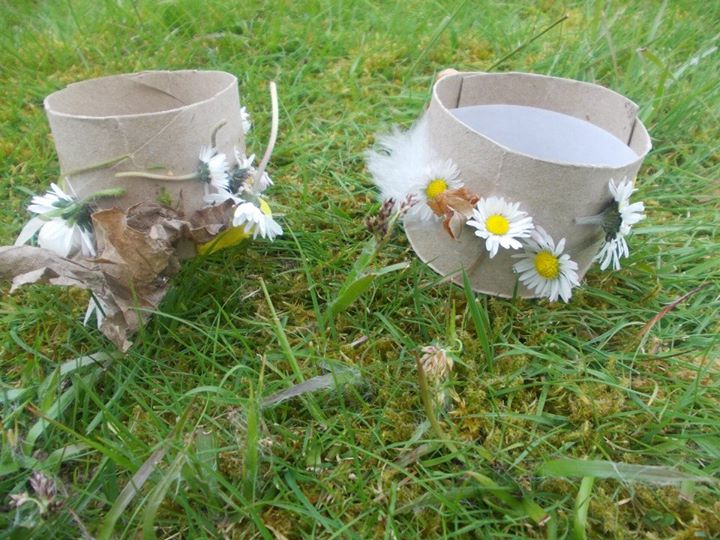
Nature Bracelets


I was delighted with how this activity worked out! 
It was popular with both boys and girls, it was completely the children's own work and they got SO much learning out of it, including... 
  • Investigating different kinds of plants and flowers
  • Comparing sizes of leaves, flowers and our hands as we tried to fit them through the bracelet
  • Noticing colours
  • What happens to a plant/ flower once it has been picked
  • That we all have our own likes and dislikes, and that I can find something beautiful even if others think it is ugly

 The best part is, you only really need 3 things:
  1. Toilet roll tubes, cut into bands
  2. doubles sided tape
  3. An outdoor area full of natural treasures (a dry day is preferable as wet leaves etc don't tend to stick quite as well)

Potions! 


This one takes me back to my childhood! Did anyone else spend hours making flower potions and petal perfumes? It was so much fun!

All you need is:

  1. A range of flowers, plants, herbs, mud and other interesting ingredients
  2. A few bottles or jugs of water
  3. A large bowl/ bucket for mixing or lots of bowls for individual potions
  4. Some empty bottles or containers for finished potions
  5. Spoons for mixing
  6. (optional) pipettes, funnels, food colouring, glitter
 I love the way that this activity has no rules and can be totally different every time.
"But what are they learning?" I hear you ask. Well...
  • Textures, smells, sights and (sometimes) tastes of plants and herbs
  • Language that describes (smelly, slimy, squishy, soft, wet, dry)
  • Problem solving, trying things out and predicting (for example - "what will happen if I add more water?")
  • Hand, eye co-ordination through pouring, scooping, mixing
  • Imaginative play - what does your potion do? Does it make you fly? Does it make you HUGE like a giant?
  • Quantities and measurements (for example adding 2 scoops of mud)
  • We also practised teamwork and compromise by all working together to create one big potion

Again, there's so much more and you could easily extend this activity to cover more areas of the curriculum for example creating a pretend shop to sell their potions/ perfumes and learning about money and coins, or by creating a potions recipe book, involving mark making, early writing, numbers and quantities. You could read stories about witches, wizards or fairies or you could even use this activity as part of your Halloween festivities!


Get outside and have some fun with nature - and report back with lots of exciting ideas!