Showing posts with label learning. Show all posts

Monday, 16 March 2015

2, 2 minute talks

... Continuing from my previous post about university interviews, here are the 2 short talks that I prepared and gave.

The first talk was regarding homework in primary schools:

"Homework has been the topic of controversy for many years; not only within the UK but around the world with some teachers and groups such as the Parents Outloud charity calling for schools to abolish it all together; following in the footsteps of some areas of Europe such as Denmark which has piloted homework-free schools.
John Hattie (Professor of Education at the University of Melbourne) described homework as “low hanging fruit” in a recent BBC interview, continuing with the surprising finding that homework in primary schools in fact has no impact on children's achievement. Despite this, he does not call for homework to be abolished, but rather for teachers and schools to rethink the value of the tasks and work that they are setting.

I am involved in many discussion groups on the social network 'twitter', where professionals from the early years, primary and secondary sectors can share ideas and discuss relevant issues. During these talks I have found that many Primary Teachers share the feelings of Professor Hattie that homework can be beneficial to children if it is used to reinforce the learning that takes place in the classroom, however it is vital that homework is planned with the same rigour as lessons and involves stimulating activities, rather than just tedious or 'boring' tasks.

On reading many of the Homework Policies for (my town's) Schools, I found that homework is promoted as a valuable link between home and at school, allowing parents to become involved in the learning and development of their children. Many parents wish to be helpful and engage with their child's education and well planned homework can allow them to do this. Unfortunately it can also be said that homework is a major cause of friction and stress within many households, which raises the concern of children being discouraged from learning as they begin to associate work with being source of conflict with parents rather than a positive learning experience.

Completing homework can provide children with many valuable skills such as time management and responsibility and abolishing homework would be damaging as it prepares them for high school and later life where increasing amounts of self led learning is essential.
Despite this it is also important to remember that children need appropriate amounts of 'downtime' and that there must be a degree of separation between home life and school. Especially for children with difficult home lives or for those who find school particularly challenging.

When setting homework, teachers should take into consideration that extra curricular activities such as sport or drama clubs allow children to continue their learning in different ways. If vast amounts of homework is set then children who engage in these extra activities are left with less and less time to relax and recharge before beginning the next day. Professor Hattie pointed out in his study that 10 – 20 minutes of homework is just as valuable as 1 – 2 hours. This again comes back to the quality of the homework being set.

In conclusion, In the hands of passionate, skilled teachers; I feel that homework can be a valuable tool to extend learning and to enrich knowledge that is learned in the classroom. However it is vital that homework is planned and only given when it will benefit the children's learning rather than being set simply because a policy says so."


My second talk was about outdoor learning:


"As the interest in learning and playing outdoors continues to grow both in the UK and internationally, I have decided to speak to you today about some of the benefits of outdoor education and learning through nature.

Outdoor education defines any learning that takes place outside of the school walls, whether it be in a playground or further afield in a forest or on a beach. In Scotland we are lucky enough to have access to a huge variety of natural environments and it is essential that children are provided with opportunities to explore the wonder and magic of their natural surroundings throughout their education.

The curriculum for excellence states that in order for children to develop into Confident Individuals, they must be provided with opportunities to be active. There is a frightening prediction in The Foresight Report (2007) which concluded that half of the UK population could be obese by 2050 and with the temptations of technology such as television, ipads and video games, it is easy to see this becoming a reality.
By taking children out of the classroom and engaging them in outdoor learning, teachers are able to promote the benefits of an active lifestyle and the enjoyment that goes alongside exercise.

Outdoor education allows for many different learning styles, from visual to kinaesthetic and provides children with relevance and depth to the curriculum as they are able to apply their learning within real life contexts. Learning in this way promotes self esteem and confidence, it can also be used to teach team work and problem solving as well as improving attitudes towards the environment.

From my own first hand experience working within a pre school which promotes outdoor education and forest school experiences, I have witnessed the positive impact of outdoor education, including increased motivation and enthusiasm for learning, that continues even on returning into the classroom environment.

Of course, there are many factors which must be given careful consideration when taking learning outside. Risk assessments must be rigorously completed and accessibility for all students, including those with additional special needs must be taken into account. However, with careful planning and preparation, teachers are able to overcome these challenges in order to provide valuable experiences for the children.

I believe that taking education out of the classroom gives them access to a wealth of benefits and by allowing children to explore and investigate of our natural world, together we can ensure that learning is powerful, exciting and rewarding."


Keep in mind, I had a 2 minute limit for each, and there is so much more I could have said about either topic!


Sunday, 14 September 2014

Lovely Lightboxes

Good evening everyone! I thought that today I would devote a post to a fantastic, sometimes a little under-appreciated resource - the Lightbox!


If you don't already have a lightbox (sometimes known as a light table) - don't panic! You can make your own quite easily by putting a lamp or some fairy lights into a large plastic container.
A nice simple tutorial can be found here.

Ok, first things first; in order to use your lightbox effectively you must put some thought into where  you'll put it and how you'll present it - hopefully making it into an exciting invitation to play!
My favourite way to set it out is to have the lightbox on a low table, or even set on the floor, so that it is easily accessible and at child height, and place it against a mirror, or better yet - surround it with a 3 sided mirror! 
There are some lovely examples of how to set out your light boxes on pinterest.

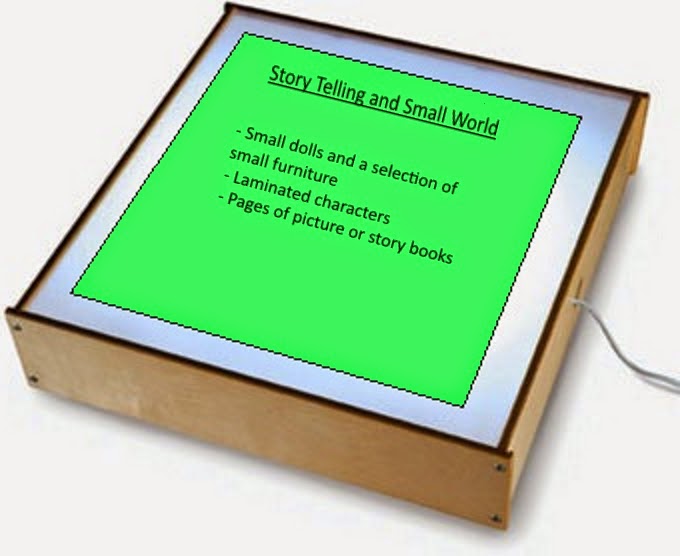
Now that your lightbox area is set up, you can start thinking about the skills that you want the children to be developing, and the resources that you can add to promote these skills!

Here are just a few ideas:


As well as these general ideas, there are many other ways to involve your lightbox in your learning, for example: if you are learning about the body and people who help us - you could add X-rays. If you are learning about Autumn, you could add discovery bottles with pine cones, conkers, leaves! You see? The possibilities are endless!

I find that the lightbox is a great way to encourage children to look at items in detail. It can also help children to concentrate and focus. I hope I have inspired you to have another look at your lightbox!

Here are some more fantastic lightbox ideas to inspire tou from blogs around the web:

Ice on the lightbox by Garden Gate Child Development Centre

A beautiful glittery light table by Fairy Dust Teaching

A huge selection of 'everyday' ways to use your lightbox from Teach Preschool


Thursday, 10 April 2014

Fire Safety Fun

I know I know, this is supposed to be another instalment of my Outdoor Learning Ideas - and I am in the process of writing it (I promise) but I'm finding it a bit of a chore now and I don't want to become stale - so I thought I would write about some learning that I was particularly happy with!

My nursery recently took part in the NDNA's 'Healthy Body Happy Me' week, where the children were able to access a huge range of activities that were linked to a healthy lifestyle. As part of these activities, the children were able to take part in many outdoor experiences: one of which included toasting marshmallows over a camp fire!
This was a very popular activity with the children who immediately took it into their free play and began building their own pretend camp fires out of sticks, leaves and anything else that they could get their hands on! 

Now in my nursery, we have covered the usual 'people who help us' angle of learning about fire and fire-fighters so we decided that, in keeping with the children's interests, and to allow us link in with the curriculum for excellence, we would have a fire safety week!

Some of the my favourite activities included:

  • Building a fantastic fire engine that the children can climb in and out of.
  • Creating our own small world 'burning town' out of cardboard boxes and fire coloured tissue paper - complete with paper characters and a Fireman Sam to rescue them.
  • Mark making and practising writing related words such as 'emergency' and '999'.
  • Going on a hunt around the nursery to discover our smoke detectors.
  • Continuing this learning at home as we took a picture or noted down where our smoke detectors can be found.
  • Many discussions about how to keep ourselves and others safe in an emergency.
  • Reading many fire-fighter stories.
  • Painting a life sized Fire fighter and discussing his uniform, why he wears it and what materials it may be made from.

Now, all of this adult lead learning is great, but it's impossible to know how much of it is sinking in and being processed. That is, until you observe their free play, which is exactly what I did...

The children were outside in the garden. They had worked hard to build a den and furnished it with tables, chairs and a tea set. The girls set about having their tea party while one boy was busy sweeping the floor ("I'm the cleaning man"), and another boy used a toy hammer to 'fix' each side of the den. 
Suddenly one of the children started making a horrible screaching sound! I wondered what on earth was going on and was about to intervene (thank goodness I didn't) when I heard another child call "That's the smoke alarm! Everyone go outside!"
Each child hurried out of their den and stood outside. One little girl held her hand to her ear and said "999! Fireman come fast, there's a fire!" and I heard a voice from the other side of the decking (another boy who was involved in the game) call "I'll be there soon!"
The children waited patiently until the boy who was previously the 'cleaning man' decided to go inside. The children all called "No, no! It's on fire!" but the boy said confidently "It's ok, I've got my special jacket on! I can put away the fire." He then proceeded to use his broom as if it were a hose and waved it around the den. He was joined by the other little boy from across the decking (who was also pretending to be a fireman), and had brought a bucket full of leaves which he told us was the water.
When the boys had finished they said to their friends "It's all done now" and everyone went back inside and continued to play.

What fantastic evidence that they children know and understand what to do in the event of a fire! They also show that they understand the role of the fire fighter and how a fire fighter can help to put out the fire.
They used the new language that we had introduced (i.e. smoke alarm) and not only that but there was also wonderful imaginative skills, resourcefulness and interactions between children!

This observation reminded me that the children are never JUST playing! They are always deepening their understanding, exploring new situations, practising new skills and working out what comes next. 
How lucky we are to be a part of this process!


Saturday, 22 February 2014

Observing children

As you probably know, the ability to take good quality observations is one of the MOST important aspects of a nursery practitioner's job.
Good observations allow us to:
  1. Gain an understanding of a child's development and stage
  2. Plan activities and experiences to challenge and stimulate a child at a level that is suitable for their development
  3. Discover a child's interests
  4. Identify any areas of concern
  5. Build a relationship with a child

There are many ways that we can record observations, some of which are helpful for particular situations...

(Note: Throughout this post I refer to the record of children's development as either learning journals or portfolios. You may have other names for them!)

  • Photographs – A very simple and effective way of keeping a record of an event is to snap a few photos! This clear and visual method is wonderful for involving children in their own learning journals and they can remember and relive experiences as they look at and speak about each photo. Remember it's important to add an explanation of what is happening in the photograph and identify the skills that the child is developing (even if you think it's obvious – parents or anyone from a non childcare background might not!)

  • Examples of children's work – This is lovely for building up a picture of the child's development over a period of time. For example, including a picture from when the child first began to mark make, as the scribbles develop into circles, then into faces, then perhaps a picture where a character has detail such as eye lashes and fingers! Another benefit of this method is giving the children ownership of their portfolios and allowing them to feel a sense of pride as they contribute a piece of work that they consider special in some way.


  • Snapshot/ post it notes – ALWAYS have a notepad/ roll of sticky labels/ post it notes handy because you never know when you'll spot a child achieving something new! If you take the time to watch and observe children as they 'free play' you will be able to take countless observations as they are always experimenting, investigating and problem solving.


  • Written account – This observation simply does what it says on the tin! For a set period of time (often half an hour or so) you focus on one child and write down everything that they say and do. It is a good idea to include as much detail as possible; how many children and adults are in the room, anything that may be affecting their mood (e.g. Mum has told you that they didn't sleep well last night), even the weather! This type of observation is very helpful if you have a concern about a child's development as it is more in depth than a snapshot or photograph.

  • Mapping – To carry out this type of observation, first draw up a simple diagram of your room/ play space. Clearly labelling any furniture and play activities/ experiences that are on offer. Throughout the observation, write numbers on the map to show which areas they have visited in which order. This type of observation is helpful if you are focusing on a child's attention span as you can note the times that they spend in each area. It can also be used to monitor a child's social interactions as you can note the children that your focus child interacts with and the size of social groups that they are confident to approach.


  • Time sampling –  This is another way of monitoring a child over a period of time. A practitioner is able to note down what a child is doing at regular intervals (such as 10 minutes.) In the same way as mapping, this type of observation can be useful for identifying a child's preferences. Time sampling also allows practitioners to go into a little more detail than they can during 'Mapping.'


  • Event sampling – This observation is used to allow practitioners to focus on a particular time or event that a child is finding challenging. It is often presented as a table and includes information such as the time; it could be that the time of day has a huge impact on a child – for example, if they are feeling tired at the end of the day, they may not be able to cope with louder activities going on in the room. If they are aware of the time that these events happen, Practitioners are able to note down the triggers (for example another child approaching their personal space, or Mum leaving in the morning.) We then record the behaviour that is displayed (crying, lashing out... anything that causes concern) and then the 'consequence' - as in; what happens as a result. When reviewing these observations, a practitioner may spot a simple solution to a problem (for example allowing the child to bring a special teddy in to be a comfort as Mum leaves) or review methods that may or may not be working (for example staff have tried ignoring negative behaviour and praising positive, but now may begin to try distraction techniques instead.)

  • Checklist – Checklists can be useful observations when used appropriately. They allow practitioners to quickly identify skills that a child is confident with and perhaps some that need more support. It is important to be aware of your target child's age and stage and only use checklists that are suitable. It is also important to remember that every child is an individual and develops at their own pace. You could observe 2 children of the exact same age and the chances are – their checklists would look completely different!

A couple of tips:
When observing children, it is important to focus on the positive and what a child CAN do, rather than what they can't. I don't mean you should make it up or twist the truth, but find a way to word it so that it is not negative. 

Always keep in mind the skills that the child is developing. It's great to see that they are enjoying an activity, but they're getting so much more out of it than just enjoyment!

Remember your 'Next steps' or 'What now's. Ok, it's wonderful that Little Bobby can identify a B, but how are you going to develop this further? 


Saturday, 1 February 2014

86 ideas for fabulous outdoor fun (Part 3)

Out in all weathers!

I don't want to hear any excuses! Make sure your children (and you) are dressed appropriately, whether that means wellies or sun cream, and get outside! 


First up: a couple of ideas for Sunny Weather  


  1. Have you tried shadow tracing? Get some chalk and a clean part of the path, or some big paper and encourage the children to experiment with tracing around the shadow shapes that they can see. You could let them trace each others shadow, try to trace their own (not an easy task!) or even use some construction materials to build models that will cast unusual shapes. This activity develops children's hand-eye coordination, imagination, and allows them to begin thinking about light and how it travels. You could extend this activity by creating some shadow puppets or exploring the way that shadows move and change throughout the day. What happens to the shadows on a cloudy day?
  2. Have a water fight! What better way to spend a hot and sunny afternoon than throwing and catching wet sponges (spatial awareness, coordination, gross motor skills), running past the spraying hose (gross motor skills, confidence), and finding ever more ingenious ways to soak one another (logical thinking, problem solving)? On top of this, the children are learning about how water moves and can be transported, they are also learning about evaporation as they notice their clothes becoming dry in the sun. I recommend a thorough risk assessment of this activity as wet surfaces and running can often be a dangerous combination. Oh, and don't forget to have a change of clothes for yourself as well as the children! I have made this mistake before!
  3. Sunny days are the best kind of days to go on a bug hunt! Encourage the children to think about what kind of creatures might live in the garden, then get out there and find them! Don't forget your magnifying glasses, bug books and creature catching pots to further their investigations! This activity allows children to appreciate the world around them, think about the many different creatures that share our world with us. It also develops their investigation and natural curiosity
There are so many more, but I couldn't possibly write about them all! Next, Rainy days

  1. Rain Catchers are an easy way to bring some numeracy into the outdoor environment. A very simple method to create one is to use a 2 litre pop bottle, cut it in half and insert the top end into the bottom so that it forms a little funnel. You could allow the children to use a ruler and marker pen to create markings on the side of the bottle so that they can easily measure the volume of water. A lovely experiment that you and your children can carry out is to place a few rain catchers in difference places around the garden - out in the open, underneath a tree, on top of a slide... leave them for a time and when you return, investigate which contains the most rain water. Encourage the children to think and reason "Why could this be the case?"
  2. As mentioned in my last post (No resources, No problem!) Splashing in puddles is a wonderfully fun, messy, and surprisingly educational activity! No resources? No problem!
Again, I have barely scratched the surface,  but let's think about Ice and Snow

  1. The cold weather is a perfect opportunity for your children to learn about the different forms of water through Freezing and Melting. The children at my nursery love to go on an ice hunt first thing in the morning. Any little containers or places where water might pool is possibly hiding a frozen surprise. Allow your children to hold the ice in their hands. What happens? Why does this happen? Can we stop the ice from melting? You could also involve the children in making their own ice by leaving some small containers of water overnight. Why not drop a little toy into it to see what happens? Or some sparkly glitter? Or even paint! You could extend this activity to see if other liquids freeze in the same way - for example, Does ketchup freeze? Another extension would be to allow the children to investigate the effects of salt on ice. 
  2. Building a snowman (or woman) encourages children to work together as a team. It develops problem solving and logical thinking as they work out how to move snow from one place to another, and how to build the snowman without it crumbling or toppling over. Another learning opportunity during this activity is to explore facial features and body parts
  3. Have you ever tried painting the snow? If not then I urge you to try it! The snow absorbs the paint and the paint also causes the snow to melt a little, creating beautifully weird and wonderful patterns and designs. This activity allows children to be creative, and also develops fine motor skills (or large, depending on the equipment you might use) and co-ordination.

Last of all: Windy weather!


  1. Let's go fly a kite, up to the highest height! A fun and calming activity that can involve some teamwork (getting the kite into the sky) and can also be used to encourage sharing and turn taking. And of course if you want to take it further, you could ask the children to think about "What is wind?" "Can you see the wind?"
  2. Let's make our own wind chimes! Provide the children with a variety of items that will make a sound when the wind blows (spoons, keys, wooden tubes, bells, shells... you get the idea) and when the children have finished their creative, imaginative fun you can hang them around the garden, wait for the wind and listen to the wonderful sounds that they make. 
Next Post: Taking care of our environment

Monday, 23 September 2013

Circle times

Circle time, carpet time, together time or whatever other name you give to this learning opportunity can be one of the most challenging times at nursery... but can also be one of the most rewarding!

Challenge: Children needing the toilet.
It never fails, as soon as the children sit down together I hear "can I go to the tooooooiiileeeeet?" (just like that!) and when one child has asked, then another does, and another, and another, and another, until you have more children in the bathroom than participating in your group!
Image from morguefile.com


 Method: There's a few ways that you can tackle this, depending on the type of activity that you are leading.
  1. You could pause the activity every so often to ask the children who is needing, and allowing small groups to go at a time.
  2. You could have another member of staff to quietly and unobtrusively send children to the toilet a couple at a time. This does not interrupt the pace of the activity and leaves you free to focus on the learning.
  3. You could have a visual clue for the children, such as a wrist band. For example the children who are in the bathroom wear a wristband, when they return they pass it to the next child who is waiting. This prevents children wondering if it is their turn or thinking that you have forgotten about them.
  4. And of course, there is the classic list. Perhaps using a whiteboard where the children can wipe their name off the list once they have finished in the bathroom. This allows the children to see who is next, it can also promote name recognition.
Challenge: Children struggling to sit for longer periods of time
I must admit, I'm guilty of this one sometimes. Even when an activity is going really well, it is important to keep in mind the amount of time that the children have been sitting/ focusing for. This is even more important when working with a younger group or a group with mixed ages.
Method:
  1. This may seem obvious, but plan for your group. When you are planning your group times, remember which children will be participating. If you know that you have a younger group, you may need to plan shorter, snappier activities that you can repeat at a few different times, rather than a longer activity.
  2.  Split the group into smaller groups. If you have enough staff, it may be helpful to split a larger group into 2 smaller groups. 
  3. Take a break. If the children are participating in a sitting down activity such as 'news time' and are beginning to get restless, why not take a quick break to do something physical? It could be as simple as 'stand up, turn around and sit down again.' This very quick and easy distraction adds an element of fun and keeps the children who have already taken their turn involved.
As the children have more practise at sitting and focusing on an activity for small periods of time, you can then begin to encourage them to work for slightly longer.

Challenge: Children struggling to take turns
If your children are anything like the children at my nursery, they will be BURSTING to offer their thoughts and ideas all the time.Of course, we don't want them to think that we don't want to listen to them, or that their contribution isn't valid, but at the same time, children need to learn the valuable life skill of listening and taking turns.
Method:
  1. Visual clues are very helpful. It could be a special 'talking stick' or something that the children have created. It could be a soft toy or a item of clothing such as a cape or a necklace... the sky is the limit! Just be sure to reinforce to the children that the child who has the item is the child who is taking a turn. 
Here is a wonderful example of a Native American Talking Stick (Taken from Activity Village - click the image to follow the link)


Challenge: Fidgeting and fiddling.
It's a given, children will always find something to fiddle with! Whether it is a toy, a button, the Velcro on their shoes or their friend's hair, you can guarantee that those little fingers will be fidgeting!

  1.  Consider your environment. When preparing a group activity, try to plan so that there are the minimum of temptations around. After all, how can a child resist if the box of toys is within reach?
  2. Pick your battles. As annoying as it can be to have a child fiddling - remember, if it is not dangerous, they are not disturbing the group and if they are engaged in the activity, what is the problem? As an adult, I tend to find fiddling (clicking my pen, twisting a button, squeezing a stress ball) can help me to think! From time to time it may be worth considering letting the little things go. 

Challenge: Range of abilities
If you have a large group of children, you are bound to have a wide variety of abilities. It is important for all children to feel that they are able to take part without failure.
Method:
  1. Careful planning is the key to this one, and knowing your children well. 
  2. Allowing the more able to take on 'helper' roles such as turning the pages on the book. This can help to stop them from getting bored when less able children might need a little longer to participate or work out a problem.
  3. PRAISE PRAISE PRAISE. Whether a child is more able, less able or somewhere in between, they all need to gain the confidence to have a try. All children should feel like they have achieved and done well. 
Image from facebook.com
Challenge: Disruptive Child(ren)
It can be very frustrating when all of your hard work is being disrupted by a child or group of children. 
  1. Draw attention to the positive, not the negative. For example "look how lovely Tommy is sitting!" instead of "look at Billy being silly". We all love to be praised, and children will usually respond to this praise by imitating the good behaviour.
  2. Stay calm and pick your battles. Yep, I'm using this again! Remember that negative attention is still attention, and can affect a child's self esteem.
  3. It's not always possible, but it might be worth removing the disruptive child(ren) and taking them to do another activity with a different member of staff. 
Remember: Sometimes activities don't work. It's important to recognise when the children are not engaged or when an activity is not working to plan. This way you can adapt it, alter it, or even scrap it and try something new! The activity is for the children's benefit so, if they are not engaged, it's time to try something else.

At my nursery, we also use visual cues to remind children of our 'Rules of the carpet'. These simple rules are displayed in picture form which the children can easily identify and we regularly remind ourselves of them. There are some nice clear example here: http://www.twinkl.co.uk/resource/t-m-286-good-sitting-cards 

I wish I could say that I remember all of these and follow my own advice, but at the end of the day, I am a human. Sometimes I am not as patient as I should be, sometimes I am more focused on what I want to achieve rather than what the children are achieving... but I try every day to provide the best possible experience for the children. 
If you have any methods or challenges during your own group times, I would love to hear about them!

Wednesday, 4 September 2013

Optimus Prime - eat your heart out!


Today I was lucky enough to attend a CLPL (career long professional learning) course called 'cooking bus'. 
"What a bizarre name" I'd thought while signing up,  and I wondered what on earth it could mean.
 As I drove in this morning I concluded that it must be some fancy new resource or gadget to help while cooking with children.  Imagine my shock then when I arrived at the address and found a huge lorry that had transformed into a beautiful classroom come kitchen. And it wasn't as if it used to be a lorry and had been re-made into this classroom, oh no! It had sections that moved out, and then the moving parts all slotted back together again when it changed back into it's lorry form, ready to hit the road - Amazing!
Now, anyone who knows me, knows that I cannot cook for love nor money! I'm a dab hand at making toast, and I can re-heat an oven meal no problem, but as for cooking with real ingredients? I have a serious case of 'can't cook, wont cook'. This being said, I was excited to get on the bus and see what the lovely ladies had in store. They welcomed us in with coffee and the temptation of raspberry muffins (all the best courses offer you treats!) and then we were invited to learn about diets, nutritional needs, packaging and information and they also busted a few myths about food. 
This reminded me again of how lucky we are at my nursery to have all of our meals cooked on site by a wonderful and talented cook who really cares about giving the children healthy meals.
Then, the fun bit! We were able to do some cooking! The ladies didn't give us any recipes, but rather they demonstrated the methods and techniques that we should use and that we should teach to children when carrying out food technology activities.
I was rather proud of the 2 sample dishes that I came away with! It just goes to show that with a bit of encouragement and instruction, anyone can cook or prepare a healthy meal (even me!)

I definitely feel equipped to try and bring a bit more adventure into our food technology at nursery! I will report back on how it turns out so watch this space!

For more information about the cooking bus, please visit the cooking bus website!