Sunday, 14 September 2014

Lovely Lightboxes

Good evening everyone! I thought that today I would devote a post to a fantastic, sometimes a little under-appreciated resource - the Lightbox!


If you don't already have a lightbox (sometimes known as a light table) - don't panic! You can make your own quite easily by putting a lamp or some fairy lights into a large plastic container.
A nice simple tutorial can be found here.

Ok, first things first; in order to use your lightbox effectively you must put some thought into where  you'll put it and how you'll present it - hopefully making it into an exciting invitation to play!
My favourite way to set it out is to have the lightbox on a low table, or even set on the floor, so that it is easily accessible and at child height, and place it against a mirror, or better yet - surround it with a 3 sided mirror! 
There are some lovely examples of how to set out your light boxes on pinterest.

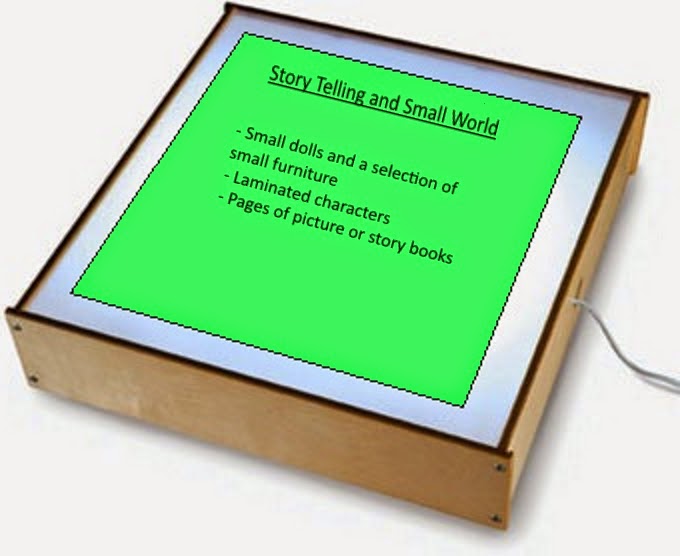
Now that your lightbox area is set up, you can start thinking about the skills that you want the children to be developing, and the resources that you can add to promote these skills!

Here are just a few ideas:


As well as these general ideas, there are many other ways to involve your lightbox in your learning, for example: if you are learning about the body and people who help us - you could add X-rays. If you are learning about Autumn, you could add discovery bottles with pine cones, conkers, leaves! You see? The possibilities are endless!

I find that the lightbox is a great way to encourage children to look at items in detail. It can also help children to concentrate and focus. I hope I have inspired you to have another look at your lightbox!

Here are some more fantastic lightbox ideas to inspire tou from blogs around the web:

Ice on the lightbox by Garden Gate Child Development Centre

A beautiful glittery light table by Fairy Dust Teaching

A huge selection of 'everyday' ways to use your lightbox from Teach Preschool


Saturday, 30 August 2014

86 ideas for fabulous outdoor fun (Part 4)

Well, it certainly has been a while since my last post! Apologies for this but I have been a very busy cookie - I have left my position at the nursery to return into the world of education. I have finally decided to take that big step and train to become a Primary Teacher! Wish me luck!

The other, very exciting, thing that has taken up an awful lot of my time is... I got married! On the 9th of August I was lucky enough to become the wife of the most fantastic man, and enjoy the best day of my life surrounded by family and friends.

Anyway! Enough about me - let's get back to thinking about the children and the many, many, many, MANY fantastic outdoor learning experiences


Caring for our environment


It's so important to teach children about the wonder of our environment and our impact on it. Here are a few ideas to get children thinking and caring...

Creating habitats


Attract creatures to your garden by building some simple habitats:


  • Minibeast home - You can use some natural resources to build homes for creepy crawlies. Use sticks and logs of all different shapes and sizes to create lots of nooks and crannies. Alternatively a cardboard box or an old pop bottle could be used. You can also use leaves or soil/ compost to create damp areas as well as dry. The best minibeast homes blend in with their natural surroundings.
  • Hedgehog home - Turn over a crate and cover it with soil and other natural resources to make it blend in with the surroundings. (Oh and make sure that there is a way for the hedgehogs to get in!)
  • Bird home - You know what a bird house looks like! But why not try your woodwork skills and build a 3 sided house that you can attach to a window. Add an entrance and some dried grass/ leaves/ something to make it into a cosy home. This way the children can see right inside as the birds use the home.

What are the children learning? 
They're learning about the different types of life in the world around us. They're learning about our impact on this life and how we can help or hinder it. They're learning about designing and creating, as well as choosing appropriate materials and they're learning about following instructions and working together. Oh, and of course the skill of observing the wildlife as well!

Planting and growing

I don't think I need to go into too much detail here - whether you have a plot of land, a corner of the garden or just a window box - children are fascinated by the process of planting and growing!

Some extension activities:
- Plant a range of seeds and have a 'race' to see which ones grow the fastest
- Try and guess the plant by looking at it's seed 
- Place one pot in a dark place and one in a light place and observe the differences as they grow (or don't grow as the case may be!) 
- Keep a 'Growing Diary' with pictures, words or even photographs. This is a great way to allow the children to use all of the new words and vocab that you'll have been teaching them throughout this activity.
- Measuring the plant's growth using a range of equipment such as rulers or tape measures.
- Picking and using and fruit/ veg that you have grown and using it in your food technology!

What are the children learning?

They are learning the science of the process of growing. They are learning about the variety and diversity of plants and growth around us. They are learning maths and through measuring growth and language and literacy through recording their observations.

Bird Feeders


Here are 2 simple ways that you can make your own bird feeders:


  • Use a large pine cone, smother it in butter or lard (messy and fun!) and then roll in bird seed. Attach string and viola!
  • Take some stale bread. Use a biscuit or playdough cutter to cut it into an attractive shape. Then use a sticky substance like honey and cover the bread before sprinkling with bird seed.
Make sure to hang them somewhere which is close enough that the children can observe through a window, but not too close that the birds are too afraid to use it!

What are the children learning?
So many things!:
You could add some books/ bird spotting sheets around the window area and allow the children to recognise and appreciate their local wildlife. They are learning about their impact on the creatures around them. They are learning to be quiet and patient while observing. Add some paper and pencils and encourage them to draw any birds that they see - bringing art and creative skills into the activity.

Litter picking

It's a bit sad, but I always really enjoy this activity!

Image from amazon.co.uk
Make sure to have a chat with the children before you head out about safety - make a mind map or 'risk assessment' including the essentials - namely - we do not touch the litter! And when we return to nursery - we wash our hands!

When I lead this activity, I read the children a story called 'Dinosaurs and all that rubbish' (Michael Foreman) which is a fantastic conversation starter. I then kitted the children out with rubber gloves and litter pickers, along with a few plastic bags.
(Now, we only had a few litter pickers, so I was able to include the all important skill of turn taking throughout this activity!)
When you get outside, it wont take long (sadly) to find some litter. Watch the children's co-ordination and motor skills develop along with their problem solving as they work out how to use the litter pickers to move the litter into the plastic bag. This could also be a great opportunity for teamwork if you have some children holding bags while others use the pickers.
As this activity continues, you can talk to the children about which objects are/ are not litter. How can you tell? Do you think this object should be here? What could happen if we leave our litter on the ground? What should we do with it? ... You get the idea :)

What are the children learning?
They are learning to be responsible citizens, to care for their environment and appreciate the world around them. They are also developing their thinking and speaking skills as well as physical capabilities.

Composting

This is a lovely side activity to link in with your gardening activities.
Here is a link to the BBC site with a step by step guide to get you started!


What are the children learning?
That garden and food waste can be re-used to create something valuable! They are also learning to be patient (composting does not happen over night) as well as all of the skills they they are gaining from their planting a growing activities.


You might also like:


Part 1: Let's get physical 


Part 2: No resources? No problem!


Part 3: Out in all weathers

Wednesday, 30 April 2014

Tooth-Brushing Time! *Challenge Accepted!*

Oops - what's this? Another post before I continue my list of outdoor ideas? Shocking!

Today I had a little brainwave which I thought I would share with you! At my nursery, we sit the Pre School children down after their high tea and have 'tooth-brushing time.' 
Now this can be a challenging time for us (especially on the days that we have larger groups of children) and the children can struggle to sit for this time, let alone actually brush their teeth! 

I know my children well, and I recognised that today, our usual tooth-brush time story was not going to work! The children were full of fun and tall tales and if I had tried to read a book, they would all be offering thoughts and ideas - spraying toothpaste (and not to mention spit) everywhere! 

And so - I decided to make up a little game; very simple and to be very honest - it doesn't really teach the children anything fantastic BUT it helped to add an element of fun to a time which otherwise could have turned into something negative!

Here's how to play:

The Tooth-Brush Time Game  


  1. Allow the children to choose a song. This could be a nursery rhyme, a pop song or a song from a movie - anything that will keep their interest. (Try to avoid any songs that are too long or too short - 2 minutes being the ideal because that is the recommended amount of time for brushing teeth.) - My children chose the Gummy Bear song which I had never heard of before! They were excited to add this silly song into their routine.
  2. From here on, the game is similar to 'musical bumps/ statues'. The rules are: When the music plays they brush their teeth. When the music stops they must hold their brush up in the air.
  3. Continue to start and stop the music until the 2 minutes has passed. Simple!

Because this was the first time that I had tried this game with my children, they were happy just to take part in the game - I did not need to have 'Winners' or give any kind of rewards but these elements could be added.

Of course, Tooth Brushing can be extended into learning in many ways:

  • Why not try making a mind map with the children to find out what they already know? They will probably surprise you! 
  • Laminate pictures of the children smiling (or just showing their teeth) - use whiteboard markers to colour in their pearly whites and provide toothbrushes for the children to 'clean their teeth'.
  • Collage pictures of foods which are good for your teeth or not so good.
  • Set up a role play Dentist
  • Painting using toothbrushes


Don't forget: National Smile Month is 19th May to 19th June 2014.

Thursday, 10 April 2014

Fire Safety Fun

I know I know, this is supposed to be another instalment of my Outdoor Learning Ideas - and I am in the process of writing it (I promise) but I'm finding it a bit of a chore now and I don't want to become stale - so I thought I would write about some learning that I was particularly happy with!

My nursery recently took part in the NDNA's 'Healthy Body Happy Me' week, where the children were able to access a huge range of activities that were linked to a healthy lifestyle. As part of these activities, the children were able to take part in many outdoor experiences: one of which included toasting marshmallows over a camp fire!
This was a very popular activity with the children who immediately took it into their free play and began building their own pretend camp fires out of sticks, leaves and anything else that they could get their hands on! 

Now in my nursery, we have covered the usual 'people who help us' angle of learning about fire and fire-fighters so we decided that, in keeping with the children's interests, and to allow us link in with the curriculum for excellence, we would have a fire safety week!

Some of the my favourite activities included:

  • Building a fantastic fire engine that the children can climb in and out of.
  • Creating our own small world 'burning town' out of cardboard boxes and fire coloured tissue paper - complete with paper characters and a Fireman Sam to rescue them.
  • Mark making and practising writing related words such as 'emergency' and '999'.
  • Going on a hunt around the nursery to discover our smoke detectors.
  • Continuing this learning at home as we took a picture or noted down where our smoke detectors can be found.
  • Many discussions about how to keep ourselves and others safe in an emergency.
  • Reading many fire-fighter stories.
  • Painting a life sized Fire fighter and discussing his uniform, why he wears it and what materials it may be made from.

Now, all of this adult lead learning is great, but it's impossible to know how much of it is sinking in and being processed. That is, until you observe their free play, which is exactly what I did...

The children were outside in the garden. They had worked hard to build a den and furnished it with tables, chairs and a tea set. The girls set about having their tea party while one boy was busy sweeping the floor ("I'm the cleaning man"), and another boy used a toy hammer to 'fix' each side of the den. 
Suddenly one of the children started making a horrible screaching sound! I wondered what on earth was going on and was about to intervene (thank goodness I didn't) when I heard another child call "That's the smoke alarm! Everyone go outside!"
Each child hurried out of their den and stood outside. One little girl held her hand to her ear and said "999! Fireman come fast, there's a fire!" and I heard a voice from the other side of the decking (another boy who was involved in the game) call "I'll be there soon!"
The children waited patiently until the boy who was previously the 'cleaning man' decided to go inside. The children all called "No, no! It's on fire!" but the boy said confidently "It's ok, I've got my special jacket on! I can put away the fire." He then proceeded to use his broom as if it were a hose and waved it around the den. He was joined by the other little boy from across the decking (who was also pretending to be a fireman), and had brought a bucket full of leaves which he told us was the water.
When the boys had finished they said to their friends "It's all done now" and everyone went back inside and continued to play.

What fantastic evidence that they children know and understand what to do in the event of a fire! They also show that they understand the role of the fire fighter and how a fire fighter can help to put out the fire.
They used the new language that we had introduced (i.e. smoke alarm) and not only that but there was also wonderful imaginative skills, resourcefulness and interactions between children!

This observation reminded me that the children are never JUST playing! They are always deepening their understanding, exploring new situations, practising new skills and working out what comes next. 
How lucky we are to be a part of this process!